
Why Innerpattern?
Credit where credit is due. We’ve been obsessed with David Hinton’s book China Root, which has tagged alongside our study of the Art of War and the Tao Te Ching (more than hat tip to Norma Wong and Collective Acceleration).
China Root is about Buddhism’s early arrival and landing into Taoist philosophy and practice in China. It explores the ways that Taoism influenced what later became Zen (Ch’an being its Chinese name). In particular, we’ve been struck by the ways that early Chinese pictographs (even through modern Chinese characters) animate meanings in new ways for us.
For example, the word for temple is sì 寺 (pronounced like the ‘oo’ in ‘wood’), and its elements are a hand 手 below touching earth/land/soil 土 above. Literally, reaching to touch earth (Hinton calls it “earthalter” or “a spiritual place where one touches the generative”).
Another example: the word for original, or the Ch’an idea of empty-mind is 本 běn, or the pictograph of a tree. Or as Hinton calls it, “original source-tissue mind.”
One of the main (and tricky to grasp) differences with Western language is that these characters are not symbols – in other words, they are not representations of another entity that they are referring to. They are seen as actually activating and being made of the same essence – that is, the character 本 běn is itself also literally a tree and/or its other meaning “original mind.” What if we treated all language – poetry and prose included – in this way?
Inspiration for the name of this newsletter (and perhaps more!) comes from Hinton’s treatment of the notion of inner-pattern, or 裡lǐ。裡 contains the radicals 衣 yī (meaning clothing or covering) and 里 lǐ (meaning village or inside), suggesting the idea of ‘covering what is inside’ – or ‘the inside which is covered.’ David Hinton writes,
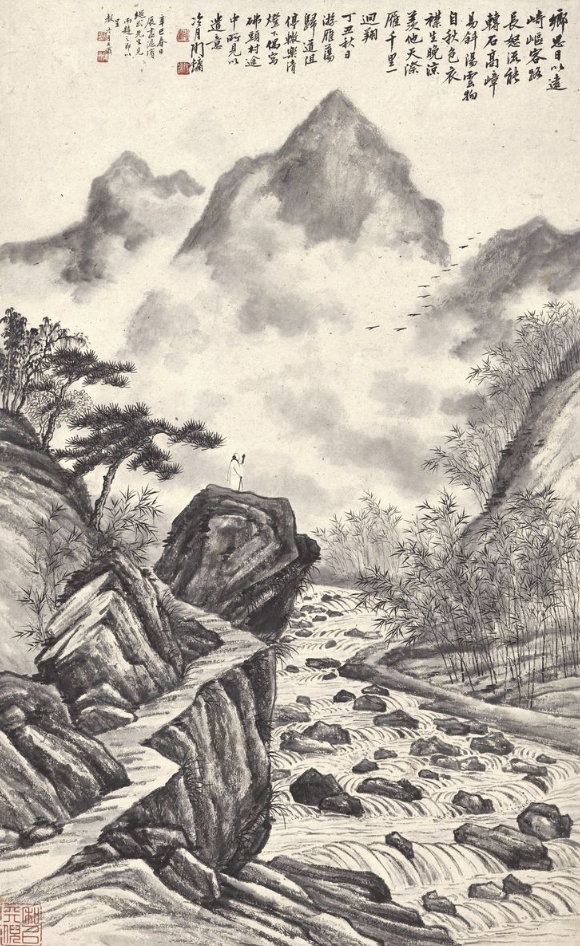
For Ch’an [philosophy], rivers-and-mountains landscape offers a way into the “inner-pattern,” a root concept in Chinese philosophy that recurs often in the Ch’an literature. Inner-pattern originally referred to the network of veins and markings within a precious piece of jade, and that is an image of its philosophical meaning: the inherent ordering pattern that shapes the unfurling of Tao or ch’i in the cosmological/ontological process of change, a concept little different than ch’i-thought/mind, which, as we have seen, refers to the “intentionality/desire/intelligence” infusing Tao and shaping the burgeoning forth of Absence into Presence.
He continues:
Inner-pattern therefore weaves Absence and Presence into a single boundless tissue. It explains the wondrous fact that matter is so exquisitely organized into the intricate forms of this rivers-and-mountains world—forests and oceans, snakes and orcas, poppies and humans—that those forms somehow appear and evolve in and of themselves and for no apparent reason. And cast against the possibility of a patternless and therefore chaotic evolution of things, as it always was in the Chinese mind, that pattern is sheer miracle.
This playground-newsletter, and our larger work, is animated by the imperfect and emergent discernment of this “inherent ordering pattern that shapes the unfurling of Tao in the process of change.” In our more operational work, this includes questions like: what is this entity (e.g. an organization, an institution, a team, a project, a movement) meant to be/become? What is underneath its form that is trying to be offered? What is its half-life**? What is it a bridge to?
Perhaps a slightly hotter take: everything has an inner-pattern – i.e. some kind of wisdom that is meant to be offered and expressed and then evolve. It’s easy to see the wisdom of a flower unfurling itself for bees to accept its pollen. Or a snowcap flowing as streams into rivers and bays and oceans. But how about being able to see the inner-patterns of the political polarization in the US? The inner-patterns of the repression of DEI work? The inner-patterns of folks that believe the current federal administration offers them the best possibility for a better life?
These inner-patterns are likely harder to appreciate. Harder to see the wisdom of, or an expression of any kind of “unfurling of Tao.” But they are inner-patterns we’re also trying to understand as part of an evolution that leaves no one and no thing left behind.
