
The consultant’s ‘’situational assessment”
Consulting is a funny gig. You have rapid and intense insight into the challenges of a given organization or community – often with teammates sharing things with you that they have not yet said to each other.
In The Consultant’s Calling by Geoff Bellman, he does the best job we’ve seen of describing this dynamic, its shadow sides, and the responsibilities of a consultant who simply as they engage to scope the work are given the task of reading the scene (the weather if you will) and to make a rapid assessment about what kinds of changes are possible and what their role, if any, would be to make a meaningful difference.
We’ve made it a consistent practice to offer new potential ‘’clients’’ a situational assessment as part of a letter of engagement that informs a proposed scope of work. We put great effort into them. And we hear interesting comments:
You really said it.
That is what’s happening.
Damn, that’s worth what we will pay you right at the very start.
Sometimes the assessment is required right at the beginning (or even before beginning), while sometimes the assessment comes later – and is more about how the project, now engaged, is reading its environment. Consultants are often paid for landscape scans or reviews – the value of a new pair of eyes and different experiences.
We want to share a few components that inform our practice of situational assessment, starting with our study of the Art of War with Norma Wong, towards practices of broadening awareness and generative tools.
Season, weather, terrain, command, and tactics
Firstly (and informed by our study of the Art of War with Norma Wong), a sound, situational assessment for us looks at these things:
Comportment with the Tao: How do you do this work in a way that embodies interdependence and thriving?
Season and Weather: What season are we in, have come from, are shifting to? What are the rhythms of the world and place that need heeding?
Terrain or Ground: Where are there openings in the terrain? What is the terrain, and how is it shifting as it relates to space and time?
The Nature of the Command: What elements and structures of leadership are needed to operationalize. (note: Norma and Sun Tzu’s teaching here is that you don’t choose the leader first but rather ask: what is the best leadership for this particular moment, following the elements defined earlier?)
Finally, methods or tactics: What methods are most effective to move what is desired?
Of course, a situational assessment does not need to explicitly name nomenclature or categorical form (like the components mentioned above), but it helps to know what is most important to look out for.
Here’s a public example of a situational assessment we worked on for the Institute for Metropolitan Studies as it looks to situate itself anew within the overlapping world of jurisdictions that have responsibility for the greater Portland area.
Begin with an Interior Assessment of Your Own Condition
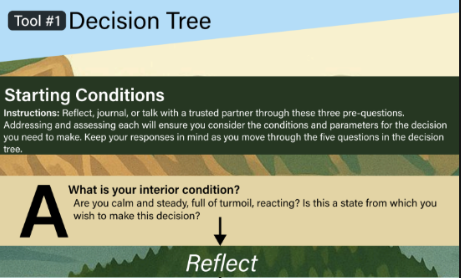
These tools were first created as part of COVID-19 pandemic response for school leaders needing to make difficult decisions with low-quality information. They’ve been updated and expanded by the PSU Center for Public Service.
For the purposes of situational assessment, we’d like to point to the very important starting point: An assessment of interior condition on page 5, which asks about your initial state of being.
A Tool for Team Self-Assessment
Moving from interior self-assessment to assessing our teams, organizations, initiatives, movements and more, in work we did last year with Collective Acceleration, with loving nods to Helen Kim, Tammy Johnson, and Nan Stoops, we generated a team self-assessment here.
The goal of the workshop it was created for was to help small teams locate themselves and any patterns they are tending to in order to find ways to move forward with more focus and potency. It’s a renewable task given constantly changing conditions and can help the “set” and “reset” process needed when aiming to pivot or make operational moves tied to purpose.
The constant dynamic of ‘’seeing’’ differing things

Duck or rabbit?
Diversity of perspective is a potent way to get a better situational assessment – whether within yourself or amidst a team. One constant source of challenge we experience is when someone is speaking from their most closely held belief and worldview and what they are saying is so distant from what someone they are speaking to can understand, it goes misunderstood or missed altogether.
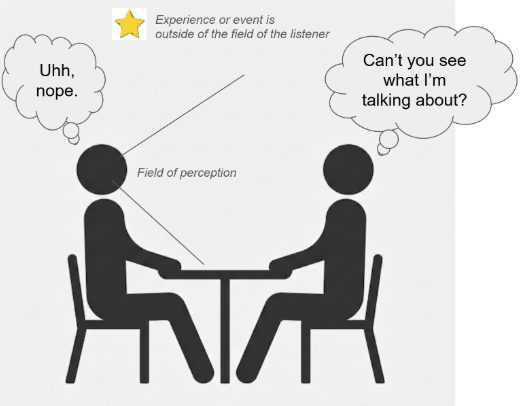
Here’s Scott’s fabulous representation of this dynamic
So what solves this phenomenon? In addition to lots of humility, the person listening can be less rigid in the way they hold their understanding - opening up space and widening the aperture of what is possible. And a speaker of experience can do what they can to start within the zone of a person’s experience and help draw them to a wider view rather than just being upset that they can’t understand. It is an age old dilemma and not this simple. But we continue to push ourselves in finding ways to help us understand each other.
The Practice of Situational Assessment
There are many components of situational assessment. We are sharing some of what we use in our practice, but we pose these questions back to you:
What are the ways you assess a situation?
How often do you re-assess?
In this constantly changing world what are the best tools and practices you have to read the weather and the terrain in ways that help you move and don’t get you stuck?
Reach out and let’s talk!
